Choosing an LMS for European teams in 2026
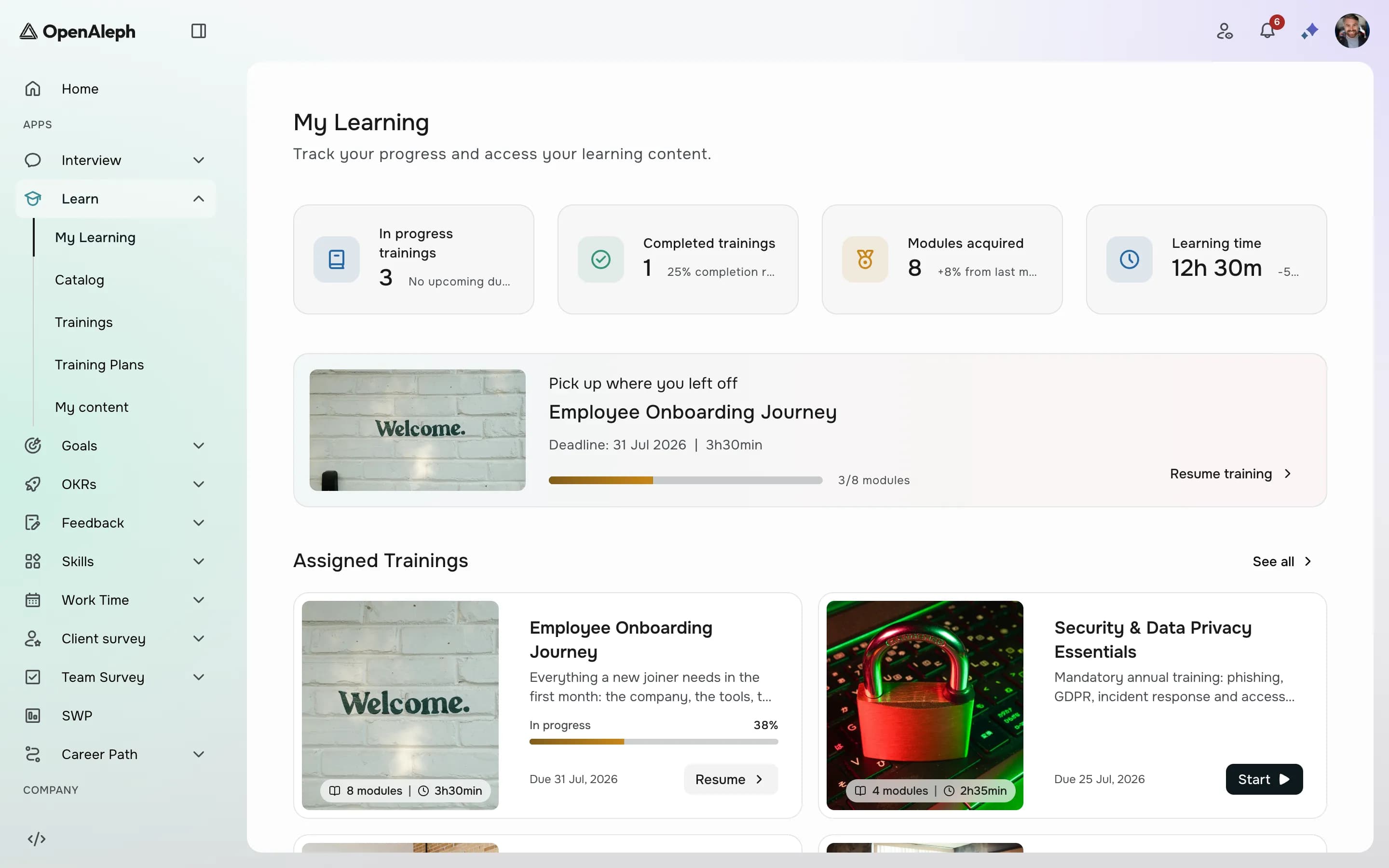
Buying a learning management system used to be about content libraries and completion tracking. For a European company operating across borders, the questions in 2026 are different — and most legacy LMS platforms answer them poorly.
Languages come first
A team spread across Europe reads in more than one language. Ask which languages the interface supports and, separately, which languages the content can be delivered in: they are rarely the same list. Translating every module by hand for every country doesn't scale; translation built into authoring does.
Authoring that keeps up
Most of an L&D team's time goes into producing content. Look at how a module is written, how its evaluation is built, and whether an audio version can be made for people who learn away from a screen.
What to look for
- Content languages: modules, evaluations and narration delivered in the languages your teams speak.
- AI authoring: help writing a module, its quiz and its audio narration, reviewed before anything is published.
- Evaluations and certificates: quizzes, self-assessments, face-to-face evaluations, and certificates anyone can verify.
- Training management: sessions, costs and providers in the same place as the content.
- External learners: partners and clients trained on the same content, without access to your HR data.
- Data protection: where learner data is hosted, and the GDPR documents, in writing.
- One profile: learning history next to the rest of the employee record.
In OpenAleph, that is Learn: modules written with Aleph AI and translated into six languages (English, French, German, Italian, Spanish and Swedish), quizzes, self-assessments and face-to-face evaluations, certificates with a QR code, training management as an option, and Academy for learners outside your company — with every training a person follows on their employee profile.
Products in this article
See OpenAleph for yourself
Book a walkthrough built around your team.
More articles
- EngagementFrom answers to actions: running an engagement surveyAn engagement survey is easy to send and hard to use. Anonymity, questions, results and the next round: how to run one people trust and HR can act on.
- GoalsOKR or individual goals: which one, and whenBoth are called objectives, and companies often run one when they need the other. What OKR and individual goals are each for, and how to write key results that measure.
- SkillsHow to build a skills matrix from a competency frameworkA skills matrix usually starts as a spreadsheet and stops being true the day a job changes. Here's how to build one from a framework, review cycles and a talent matrix.