How to build a skills matrix from a competency framework
Every company has a skills matrix somewhere: a spreadsheet with people down the side, skills across the top and a rating in each cell. It's useful the week it's made. Then someone changes jobs, a skill is renamed, a manager rates on a different scale, and nobody trusts the file any more. A matrix that stays true needs three things: a framework, reviews to fill it, and a view that turns the ratings into decisions.
Start from job titles, not from people
Don't list skills person by person. List them once, in a company framework, and attach each skill either to everyone or to the job titles that need it. Each person's review form is then built from their job title: a new hire is reviewed on the right skills in their first cycle, and after a promotion the next form follows the new job without anyone editing a spreadsheet. In Skills, every skill also has a description, which reviewers see when they rate it, and a weight from 1 to 10, which sets how much it counts in the scores.
Keep the framework small
A framework with eighty skills produces reviews nobody finishes. Group skills into a few categories, such as technical skills and leadership, and write each definition so two reviewers would rate the same behaviour the same way. Categories matter beyond tidiness: they become the sections of the review form, the columns of the results and the axes of the talent matrix.
Collect ratings from more than one angle
Run the reviews as a cycle with a period and a deadline. For each person, choose who reviews them: themselves, their manager, peers or their direct reports, each writing a separate review on the scale your template sets, from 1–3 to 1–10. A manager who knows what they want to say can type or dictate a note and let Aleph AI, in beta, fill the review; each answer it fills is tagged as AI-filled until the reviewer checks and changes it.
Turn the ratings into a talent matrix
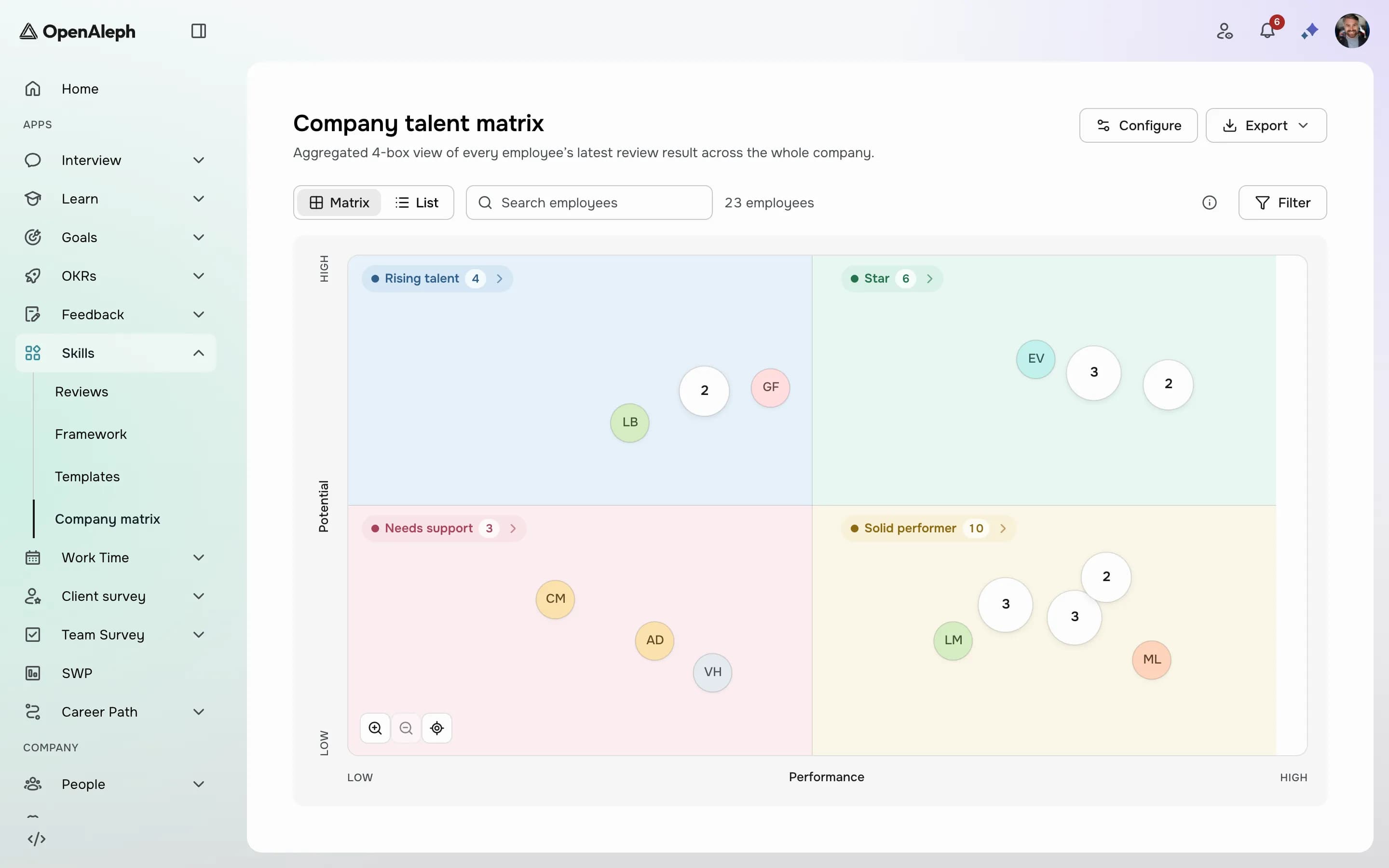
A table of ratings is hard to act on. A 4-box matrix places each person on two axes, for example performance and potential, each scored from the skill categories you choose. Ratings are converted into a percentage of the scale and averaged by weight, and a threshold on each axis splits the chart into four named boxes. Each cycle has its own matrix, and a company talent matrix shows everyone's latest result, so managers see their reports and HR sees the whole company.
Act on what the matrix shows
The point of the matrix is the conversation after it. Once a review is submitted, it can be turned into a goal for the person, with its own owner and deadline, if your company uses Goals. In the next cycle, the reviewer sees what was asked of that person last time before rating again.
Before your first cycle
- Give every person a job title: without one, there are no job-specific skills to review.
- Start with three to five categories and a short list of skills per job.
- Write each definition as an observable behaviour, not an adjective.
- Agree on the matrix axes and thresholds before the results are in, not after.
- Don't change skill weights while a cycle is being analysed: scores are recalculated from them.
Products in this article
See OpenAleph for yourself
Book a walkthrough built around your team.
More articles
- EngagementFrom answers to actions: running an engagement surveyAn engagement survey is easy to send and hard to use. Anonymity, questions, results and the next round: how to run one people trust and HR can act on.
- GoalsOKR or individual goals: which one, and whenBoth are called objectives, and companies often run one when they need the other. What OKR and individual goals are each for, and how to write key results that measure.
- ReviewsAnnual reviews people actually prepare forA form filled in the night before, a meeting spent reading it aloud, a document nobody opens again. Here's how to run annual reviews where both sides arrive prepared.