OKR or individual goals: which one, and when
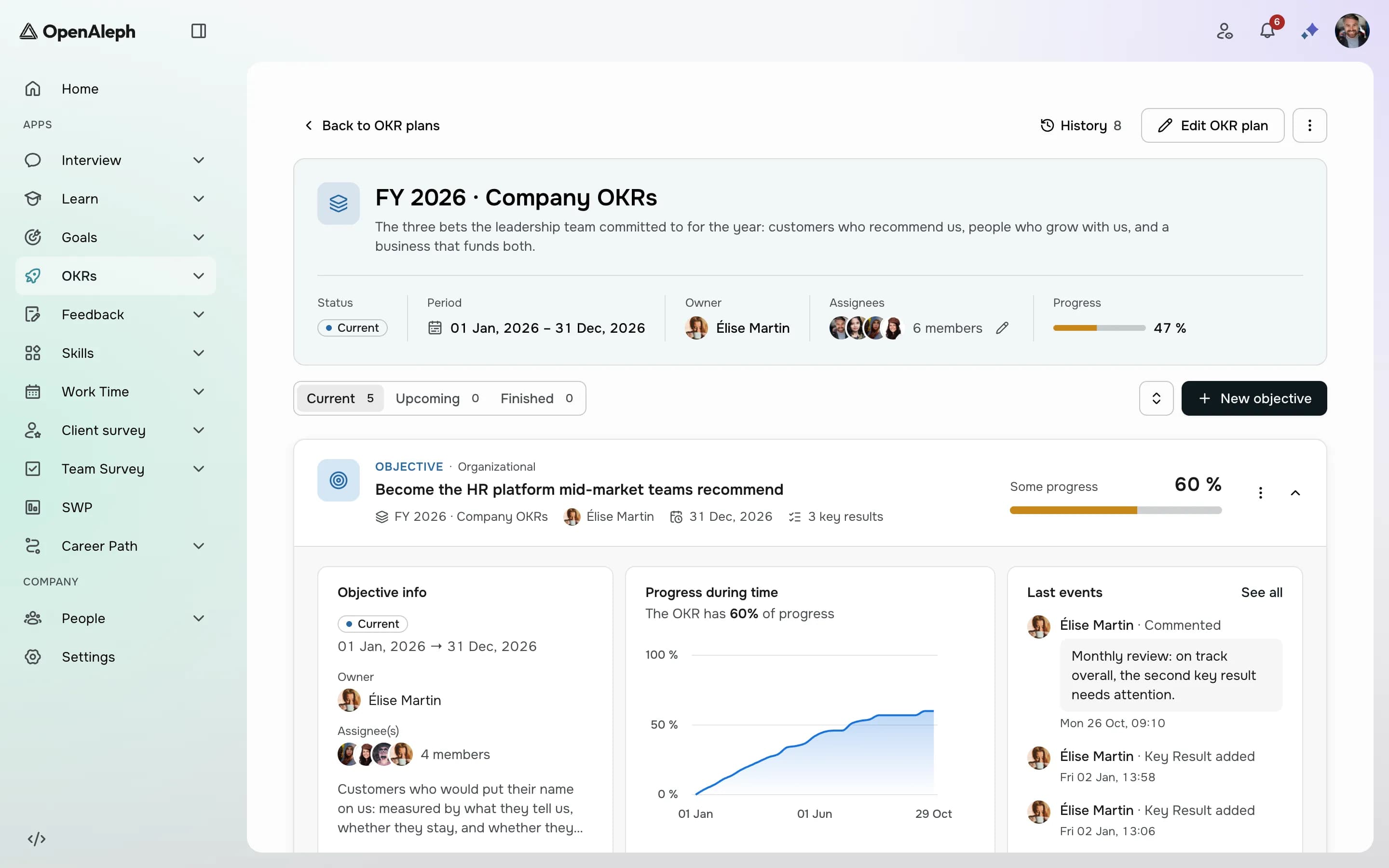
"Let's set objectives" can mean two different things. It can mean a few shared ambitions for the quarter that several teams work towards. Or it can mean what each person should achieve this year, agreed with their manager. The first is OKR. The second is individual goals. Companies that use one format for both end up with OKRs that read like job descriptions, or personal goals nobody else can see.
OKR: a shared ambition for a period
An OKR plan covers a period, such as a quarter or a year. It holds objectives, the qualitative ambitions, and each objective is measured by key results. A big key result can be split into child key results, for example one per team. Progress is calculated from the key results and rolls up to the objective and the whole plan. In OpenAleph, every OKR is visible to everyone in the company, and each item has an owner and, for shared objectives, assignees who contribute and are notified.
Goals: one person, one measure
An individual goal belongs to one person. It has a deadline, a responsible person (the manager by default) and an indicator: true or false, a number, a percentage or a choice from a list. The employee or their manager updates the current value with a comment, and moves the goal through statuses your company defines. A goal is visible to the person, their managers and HR, not to the whole company, and it can be followed from the mobile app.
How to choose
- Several people or teams contribute to the result: OKR.
- The result belongs to one person and is part of their year: Goals.
- Everyone in the company should be able to see it: OKR.
- It's a conversation between an employee and their manager: Goals.
- It comes out of a review, as a development action: Goals.
- It needs to be revisited every quarter as priorities move: OKR.
Many companies need both, and that's fine. In OpenAleph they are two separate modules that don't share data, so a key result never turns into someone's personal target by accident, and a personal goal never shows up on the company plan.
Write key results that measure
A key result has a starting value, a target and a current value, and its progress is the distance covered between the first two. That makes a few habits worth adopting:
- Write the measure, not the task: "40 client interviews" rather than "interview clients".
- Decreasing targets work: going from 20 incidents down to 5 is measured the same way.
- Avoid a target of zero; use a true-or-false key result for "no more incidents".
- Expect each key result to count for 100% at most: overshooting one won't hide another behind.
- Split a key result into child key results when several teams each own a part of it.
Products in this article
See OpenAleph for yourself
Book a walkthrough built around your team.
More articles
- EngagementFrom answers to actions: running an engagement surveyAn engagement survey is easy to send and hard to use. Anonymity, questions, results and the next round: how to run one people trust and HR can act on.
- SkillsHow to build a skills matrix from a competency frameworkA skills matrix usually starts as a spreadsheet and stops being true the day a job changes. Here's how to build one from a framework, review cycles and a talent matrix.
- ReviewsAnnual reviews people actually prepare forA form filled in the night before, a meeting spent reading it aloud, a document nobody opens again. Here's how to run annual reviews where both sides arrive prepared.